A discussion from the fufu list:
From: "J. Chris Hausler"
To: FLEX UniFLEX User Group
Subject: Re: fufu - What address does the SWTPC's 6810 start at?
Date: Sun, 12 Jul 2026 16:40:49 +0000
The evidence is that the D1 kit didn't set the standard, The MIKBUG ROM is what set the standard for the D1 kit. The MIKBUG
listing in Engineering Note 100 (the MIKBUG manual) has a 1974 date on it. And there is no reference to the D1 kit in the
manual. The manual just discusses various options for using the MIKBUG ROM. What's more the printed circuit card which came
with the D1 kit has a mid 1975 date on it. The D1 Kit came after the MIKBUG ROM was designed. I have this fuzzy memory about
hearing that Motorola originally offered a set of chips for engineers to be able to evaluate the 6800. This just included at
least the processor chip, a 6820, a couple 6810's and the 6830 ROM chip. I do not know if the second 6820 or the 6850 was
included with this original chip set. I recall hearing that this original chip set sold for $300 and did not include the
printed circuit card. Motorola began offering the D1 kit with the printed circuit card a year or so later and I know with the
printed circuit card as well as the second 6820 and the 6850 it was being sold for $150 in spring 1976.
An interesting note about this was that $150 for the set of chips was noticeably less than if you bought the chips
independently. I know of early 6800 hobbyists who bought bare boards from SWTPC and then used the chips from the D1 kit to
populate the SWTPC boards. The second D1 I acquired in late 77 was just the bare printed circuit card discarded by a man who
did this. Although the printed circuit card included a place for the 6850, I've always wondered why it included no support
for the 6850 and rather had the more complex "bit banger" serial interface using a 6820 supported. I wonder whether the 6850,
although apparently designed was available that early. I know the 6820's which came with my first D1 kit were XC parts rather
than MC, thus experimental. Further the D1 kit only included the other 68XX chips but none of the other chips and components
necessary to populate the D1 board. I later used the 6850 which came with my first D1 on an SWTPC serial card.
73, Chris
Date: Sun, 12 Jul 2026 12:52:07 -0500
From: Chris Elmquist
Yes-- Agreed that MIKBUG is what decided it-- I just meant that the D1 was
maybe the first system to have implemented it and much was replicated
after that to support MIKBUG. The RAM at $A000 and the bit-banged
console being the most obvious ones.
I have a very early EXORBUS card that implements just the 6820 + timer
circuit and RS232 and 20mA interfaces for a MIKBUG console card. I am not
sure which other EXORBUS cards it was intended to work with in a backplane
but that would have been another MIKBUG deployment without the actual
D1 board. In that sense, it is functionally equiv to the SWTPC MP-C card.
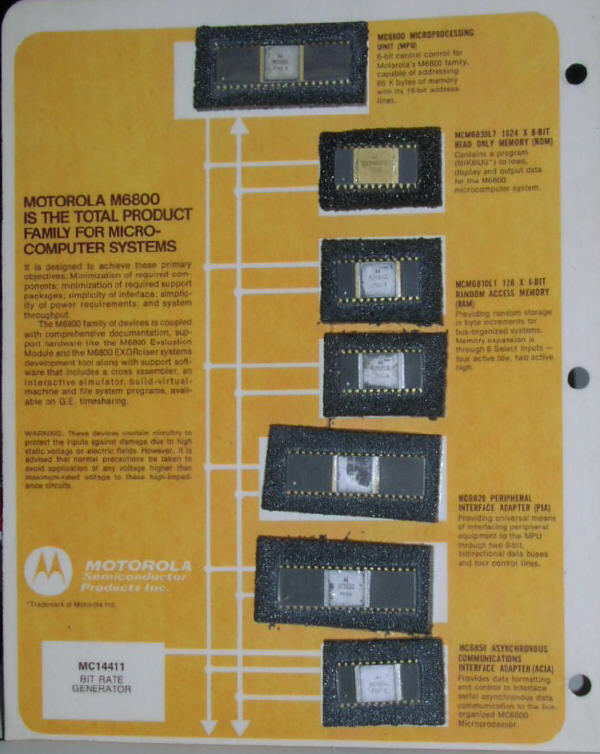
My D1 was built from the 6800 family chips that were stuck to a cardboard
"bus" in a 3-ring binder that Motorola released with all of the datasheets
for each chip in the binder. The piece of cardboard to which the chips
were stuck (in black foam and then shrink wrapped over) had artwork of
the data and address bus and control signals shown between each of the
chips and a little discussion of what each chip did.
All of these parts were labeled "XC" silicon and not "MC". So, they
were pre-release parts and I always suspected that these chips in
the binder were just for looks and not for building an actual board.
That didn't stop me though :-) That D1 still runs today with that XC
silicon in all the sockets (except a couple MC6810 filled out the rest
that weren't provided on the cardboard bus).
73, (the other) Chris NØJCF
From: "J. Chris Hausler"
To: FLEX UniFLEX User Group
Hi Chris,
I seem to recall coming across a reference to an early, already assembled, 6800 Exorbus processor card but was never able to
find any documentation on it. Maybe it was the one to require that serial interface card you have. I would be interested
in a photo of it.
I originally used my first D1 with a loaned ASR33 but lost access to it within about a year. Further, even fully populated
with 6810's the memory available on the D1 was rather limited. A problem with the D1 of which you are probably aware is that
it didn't include any data bus transceivers or address bus drivers but it would drive one external TTL load so I expanded the
D1 with an 8K CMS 2102 board. When I build up the second D1 from scratch I moved the 8K board to it and returned the first
to a stand alone configuration.
I still have both D1's but haven't run them in several decades. Once I lost access to the ASR33 I needed to implement some
form of program storage. Percom had a Kansas City Standard cassette interface, the CIS-30+, for the SWTPC. They included
instructions on how to interface it to the D1 kit which involved adding a daughter board to the CIS-30+ which implemented
the baud rate generation and interface circuitry used on the MP-C and MP-S to replace the MC14536 programmable timer on the
D1. It was connected to the D1 with a cable to a 16 pin plug.
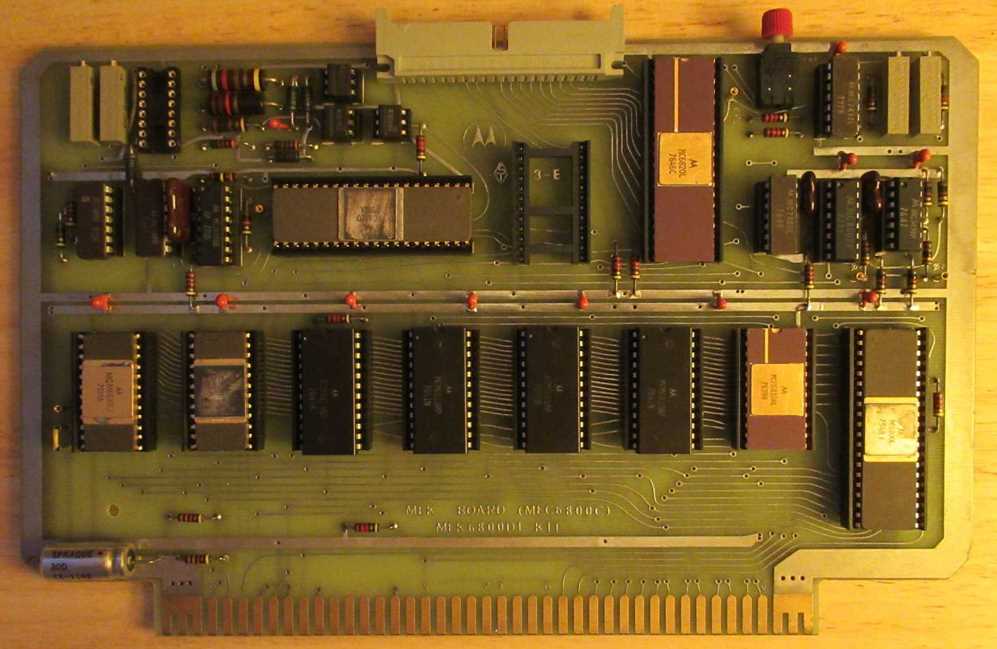
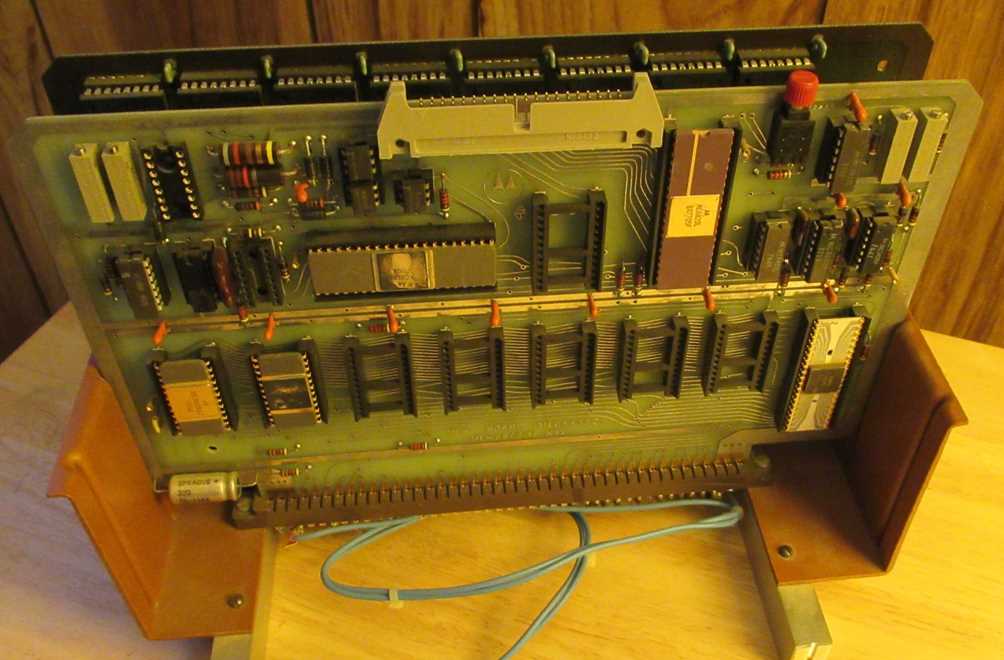
Anyway, for your amusement I have attached photos of the 2 D1's. You can see on the second expanded one that the MC14536 is
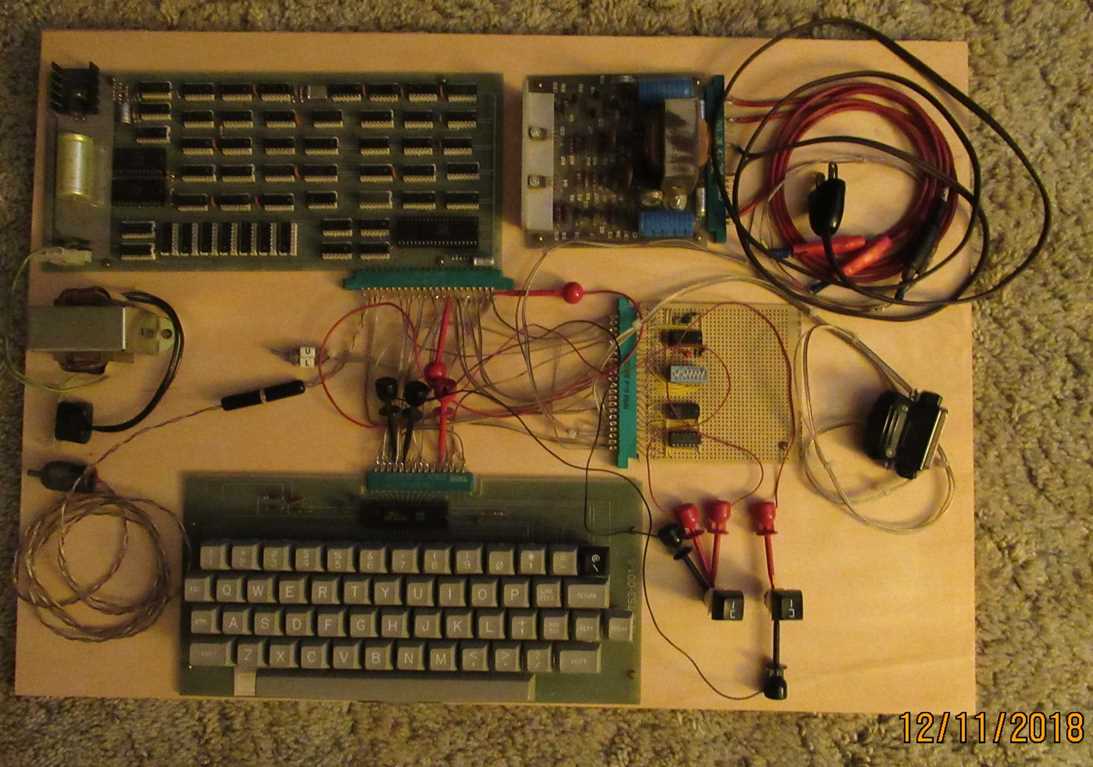
missing. Of course without the ASR33 I also needed some kind of terminal to interface to it so I constructed a "hobby" video
terminal from a purchased 64 character by 16 line kit and a George Risk 753 keyboard kit plus some additional circuitry. A
photo of it is attached or your amusement as well. I originally used a 19 inch B&W TV as the display but the resolution was
poor so I replaced it with a 9 inch B&W monitor which despite the small size showed a crystal clear easily readable image.
With the TV it was hard to tell the difference between 8's and B's in S1 records :-)
73, Chris (WB2TLL)
 Date: Sun, 12 Jul 2026 16:20:37 -0500
From: Chris Elmquist
Hi Chris,
This is a fun discussion as it caused me to go digging for what I
thought I had. I did find it but, it also proves that my memory has
poor refresh...
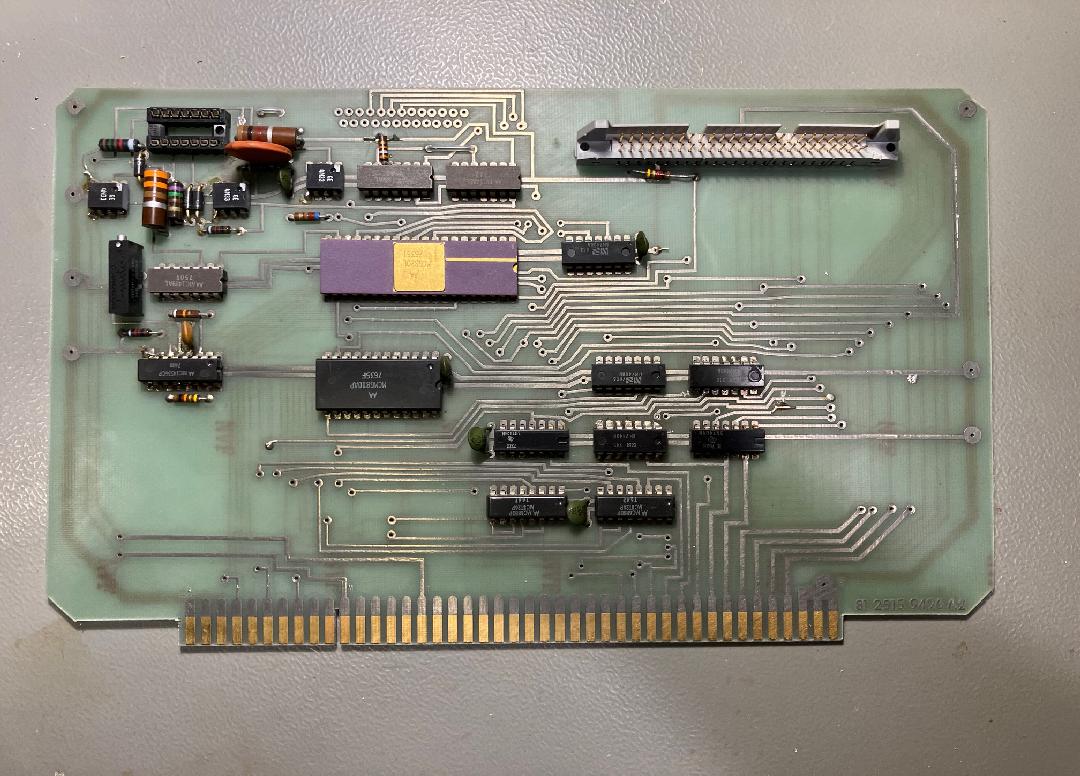
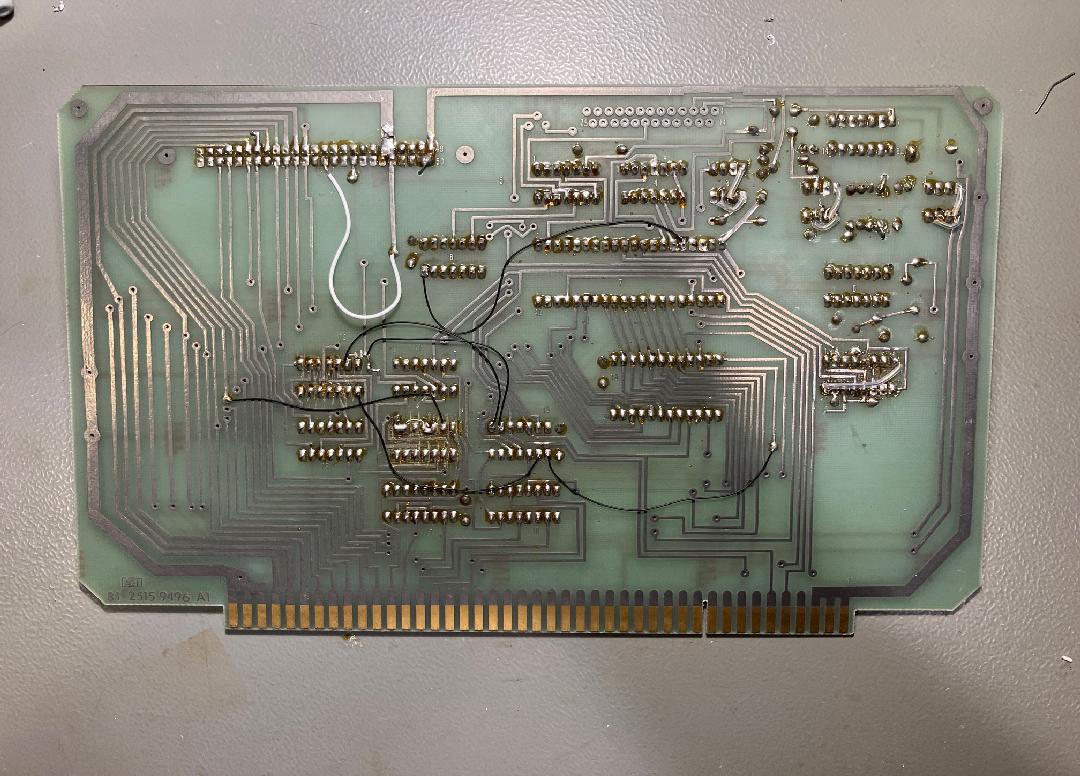
It looks like this console board is NOT a Motorola board like I mistakenly
remembered. It appears to be a third party design and although it has
a P/N on it, there are no other maker marks that suggest who did it.
I now suspect someone developed a MIKBUG interface for their EXORBUS
development system and it probably wasn't MOT.
The newest parts on the board appear to be the actual Motorola devices,
both the 6820 and the 6810 and they have 1976 date codes so it was at
least assembled a while later.
Pictures attached.
Not long after I got my D1 running, I quickly moved to the SWTPC 6800
but for both of them, for quite a while, I used a TI Silent 700 thermal
printing terminal as my console-- and I used up CASES of thermal paper
:-) I was spoiled though as my Dad worked for 3M, who made the thermal
paper for TI, and somehow the cases were always available.
I also have a CIS-30+ and remember assembling that one Halloween evening
and getting it running and finally being able to turn the machine off
and on again (famous IT Crowd quote) and being able to reload my software.
The next big step was the Percom LFD-400 and I was able to have a massive
100Kbyte storage that was instant! HA HA. The CIS-30+ went on the
shelf pretty quickly then.
I have a bunch of EXORBUS stuff that I've only stored and not had running
so this discussion gets me fired up to see if some of these boards
(beyond the D1 and D2 kits) have any life. I have 6800, 6802, 6808
and 6809 processor boards, lots of different peripheral cards (mostly
parallel interfaces with 6820/6821 on them) but some A/D stuff too.
Chris NØJCF
Date: Sun, 12 Jul 2026 16:20:37 -0500
From: Chris Elmquist
Hi Chris,
This is a fun discussion as it caused me to go digging for what I
thought I had. I did find it but, it also proves that my memory has
poor refresh...
It looks like this console board is NOT a Motorola board like I mistakenly
remembered. It appears to be a third party design and although it has
a P/N on it, there are no other maker marks that suggest who did it.
I now suspect someone developed a MIKBUG interface for their EXORBUS
development system and it probably wasn't MOT.
The newest parts on the board appear to be the actual Motorola devices,
both the 6820 and the 6810 and they have 1976 date codes so it was at
least assembled a while later.
Pictures attached.
Not long after I got my D1 running, I quickly moved to the SWTPC 6800
but for both of them, for quite a while, I used a TI Silent 700 thermal
printing terminal as my console-- and I used up CASES of thermal paper
:-) I was spoiled though as my Dad worked for 3M, who made the thermal
paper for TI, and somehow the cases were always available.
I also have a CIS-30+ and remember assembling that one Halloween evening
and getting it running and finally being able to turn the machine off
and on again (famous IT Crowd quote) and being able to reload my software.
The next big step was the Percom LFD-400 and I was able to have a massive
100Kbyte storage that was instant! HA HA. The CIS-30+ went on the
shelf pretty quickly then.
I have a bunch of EXORBUS stuff that I've only stored and not had running
so this discussion gets me fired up to see if some of these boards
(beyond the D1 and D2 kits) have any life. I have 6800, 6802, 6808
and 6809 processor boards, lots of different peripheral cards (mostly
parallel interfaces with 6820/6821 on them) but some A/D stuff too.
Chris NØJCF
 From: Stanley Ruppert
Date: Sun, 12 Jul 2026 14:58:56 -0700
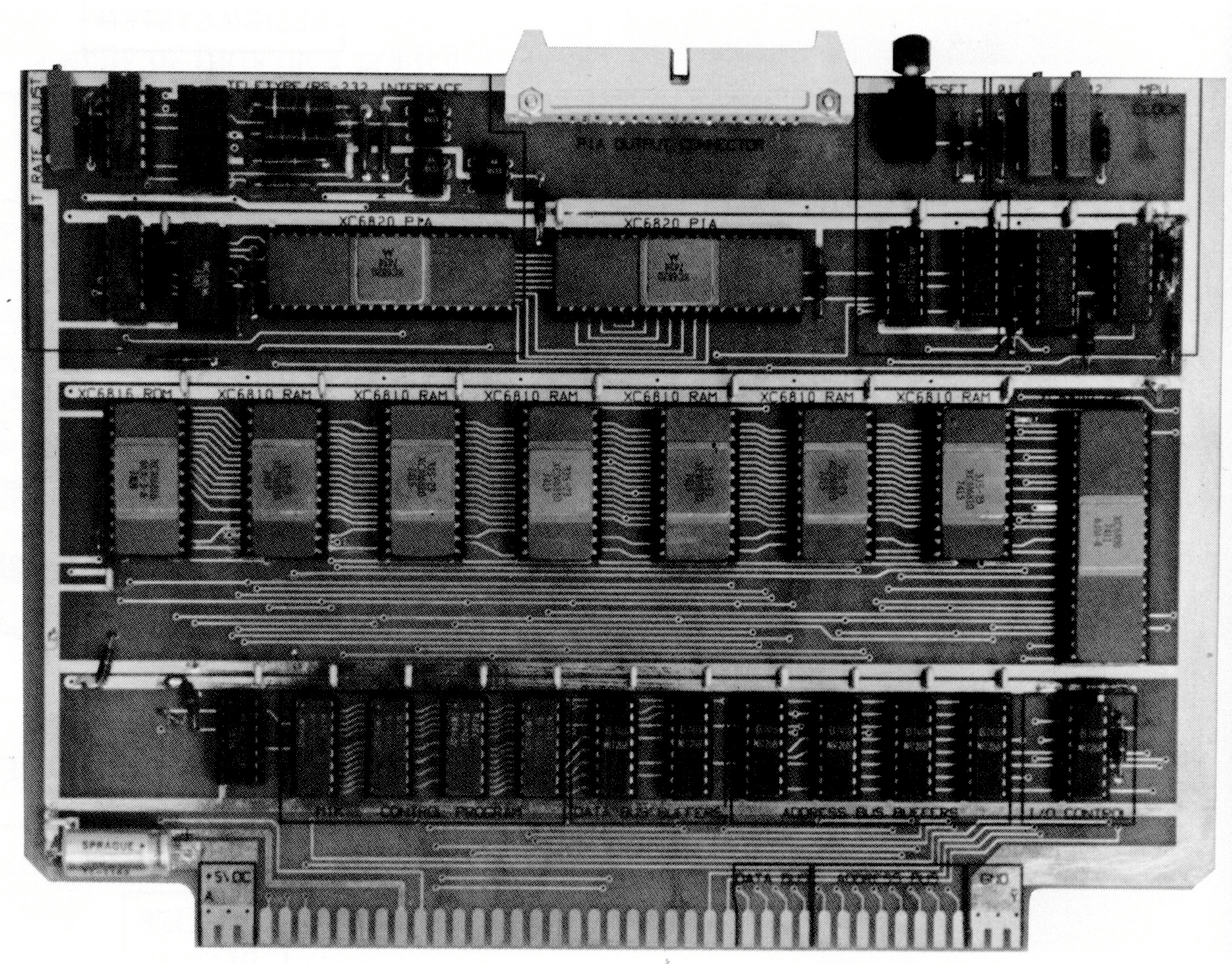
There were several versions of a Motorola Evaluation Card that predated the MEK6800D1.
The first evaluation cards date from May-July 1974 (Motorola Evaluation Module) and (Motorola Evaluation System Card - October 1974.
The Motorola Evaluation Module is described on page 7-88 of the First Edition Motorola Microprocessor Applications Manual and
in early sales literature. Scan and Schematic attached.
Note the module includes bus drivers (lacking on the D1 kit) and incorporates Mikbug in either an XC6816 ROM (later called 6830)
or four bipolar proms. Dates on the core chips range from 11th to15th week 1974.
The first version of the evaluation card included only a single resistor for adjusting baud rate.
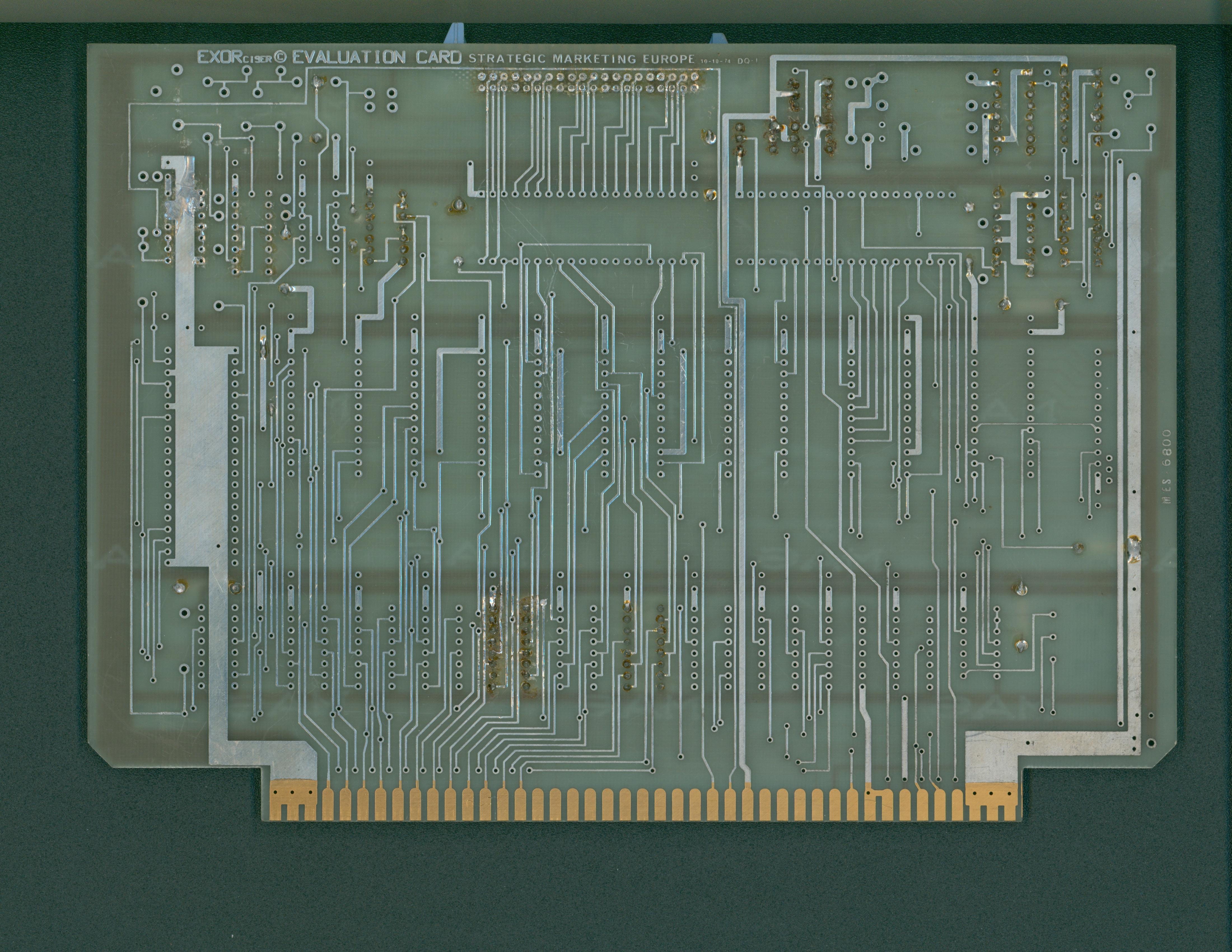
Later versions of this card (MES6800 from October 1974) added a second variable resistor for adjusting baud rates (110 & 300
switched separately) but otherwise are identical incorporating bus drivers and four alternate proms locations for Mikbug.
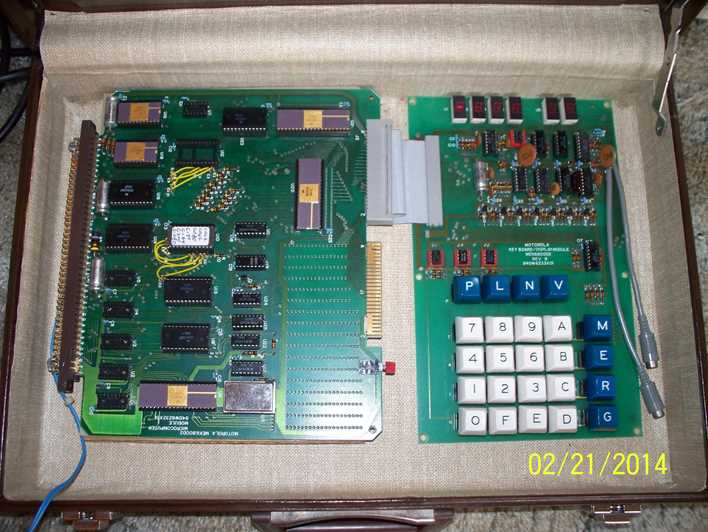
I have a mostly unpopulated MES6800 card (photo attached). Al Shapton has the full briefcase system based on the MES6800 marketed
in Europe for Sales (https://alshapton.github.io/MC6800Catalogue/Documents/Hardware/Other/%40MPUEvaluationBoard.html#mpu-evaluation-board)
The MES6800 has silkscreen EXORciser EVALUATION CARD, Strategic Marketing Europe 10-10-74. The CHM oral history interviews of
the Motorola Team references marketing trip to Europe late 1974 with the evaluation HW and SW.
The MES6800 userguide has schematics /parts lists dated May 74 and added Oct 74 revisions.
Al generously scanned his MES6800 user manual and posted on his site:
https://alshapton.github.io/MC6800Catalogue/_downloads/1d4a0fe481a64abb77f2553f79ff6f23/MES6800_User_Manual_Sep_1975.pdf
It's these early cards that were prototypes of later Exorciser Cards as they incorporated the bus buffers the 6800D1 did not.
From: Stanley Ruppert
Date: Sun, 12 Jul 2026 14:58:56 -0700
There were several versions of a Motorola Evaluation Card that predated the MEK6800D1.
The first evaluation cards date from May-July 1974 (Motorola Evaluation Module) and (Motorola Evaluation System Card - October 1974.
The Motorola Evaluation Module is described on page 7-88 of the First Edition Motorola Microprocessor Applications Manual and
in early sales literature. Scan and Schematic attached.
Note the module includes bus drivers (lacking on the D1 kit) and incorporates Mikbug in either an XC6816 ROM (later called 6830)
or four bipolar proms. Dates on the core chips range from 11th to15th week 1974.
The first version of the evaluation card included only a single resistor for adjusting baud rate.
Later versions of this card (MES6800 from October 1974) added a second variable resistor for adjusting baud rates (110 & 300
switched separately) but otherwise are identical incorporating bus drivers and four alternate proms locations for Mikbug.
I have a mostly unpopulated MES6800 card (photo attached). Al Shapton has the full briefcase system based on the MES6800 marketed
in Europe for Sales (https://alshapton.github.io/MC6800Catalogue/Documents/Hardware/Other/%40MPUEvaluationBoard.html#mpu-evaluation-board)
The MES6800 has silkscreen EXORciser EVALUATION CARD, Strategic Marketing Europe 10-10-74. The CHM oral history interviews of
the Motorola Team references marketing trip to Europe late 1974 with the evaluation HW and SW.
The MES6800 userguide has schematics /parts lists dated May 74 and added Oct 74 revisions.
Al generously scanned his MES6800 user manual and posted on his site:
https://alshapton.github.io/MC6800Catalogue/_downloads/1d4a0fe481a64abb77f2553f79ff6f23/MES6800_User_Manual_Sep_1975.pdf
It's these early cards that were prototypes of later Exorciser Cards as they incorporated the bus buffers the 6800D1 did not.
 MEC6800-EvaluationModule-Schematic-05-74.pdf
From: Stanley Ruppert
Date: Sun, 12 Jul 2026 21:15:52 -0700
A bit more fun trivia regarding the earliest Motorola Evaluation Card with MIKBUG.
From the early 1974 schematic Side Notes,
The MEC6800 board could be ordered in four different options/configurations:
Option 01 - MPU Model A, MIKBUG in single ROM XC6816 aka 6830
Option 02 - MPU Model A, MIKBUG in four 512x4 bipolar proms (Harris HM1-7621 pinouts)
Option 03 - MPU Model B, MIKBUG in single ROM XC6816 aka 6830
Option 04 - MPU Model B, MIKBUG in four 512x4 bipolar proms
Notably, the earliest revisions (Model A) of the 6800 did not (yet) support NMI
Options 01 and 02 with 6800 Model A (A1, A2) did not support /NMI interrupt (was grounded on evaluation board E3-E4 jumper)
Options 03 and 04 with 6800 Model B, did support /NMI interrupts so included additional R27 pullup resistor for NMI and removed
grounding jumper E3-E4.
From: "J. Chris Hausler"
Date: Mon, 13 Jul 2026 16:29:21 +0000
Hi Chris and Stan,
Very nice finds!!! Somewhere years ago I came across a very poor photo of one of those early boards. I never saw one "in the
flesh" however and the fact that they are apparently very rare explains why. I think the D1 was an effort by Motorola to
significantly reduce the cost so to get the processor directly in the hands of the engineers. I was working in the industry
at the time designing industrial command and control and feedback control software although on minis (Data General at the time)
and then even minis were new ideas to industry as well as my management. Management (at least mine at the time) would have been
reluctant to invest in educating their engineers about these even more newfangled chips :-)
I had been casually sniffing around micros for a couple of years but was not impressed by either the 8008 or 8080. Strangely,
early in 1976 I became interested in the F8 but further research turned me off to it. Although I had seen several copies of
Byte Magazine I bought my first one, the October 1976 issue, one Friday evening while visiting my local Heathkit store. There
were a number of articles in it which included 6800 code, I don't think I was even aware of the 6800 before this, and it
reminded me of some early experience with the first model of the PDP-11 mini (which I almost dropped on the floor due to
its under designed rack slides) while still in college. So I contacted my local Motorola sales office (eventually befriending
the sales manager) and he guided me to the kit. He also made me aware of a local hobby computer group which had formed earlier
in 76 and so I started attending their monthly meetings. I quickly became aware of a 6800 sub group and joined that as well.
Also the spring of 77 at the invite of a college friend who needed help manning his flea market booth, I attended my first hobby
computer convention in Trenton, NJ where I had the pleasure of briefly talking with John Mauchly, co-creator of ENIAC and
co-founder of what became UNIVAC, he (and his wife, an ENIAC programmer) were the keynote speakers at this convention.
Well it was all downhill from this point forward. For software for the D1, once I expanded it that summer with the 8K memory
board, I got both a 4K Basic and and editor/assembler set up for it, originally using that ASR33 as my terminal and program
storage device. At the time, the hobby magazines were casting about for ways to inexpensively distribute software. Byte
came up with "Paperbytes", a bar code system, and their first publication was for a single pass 6800 assembler. To this I
added TSC's Simple Line Editor with some enhancements to support assembly language programming and to control the ASR33's
paper tape reader and punch. I modified the assembler to control the reader. Interface Age had what they called "Floppy
ROMs" and their first one was a version of Bob Uiterwyk's 4K Basic ( https://en.wikipedia.org/wiki/Flexi_disc#/media/File:FloppyRom_Magazine.jpg ).
With only 8K total, his 8K Basic as well as Motorola's Co-Res editor and assembler were too large (with 8K I think I could
only get less than 6 lines of code in the editor before running out of memory :-). This was my "development system for the
rest of 77. Losing the TTY I constructed that hobby terminal in shown in the photo in my earlier email as well as the CSI-30+
for program storage. That was my system beginning in 1978 and several years thereafter.
However, my hobby computer efforts were more or less suspended summer 78 as I was shipped to a job site in Atlanta, GA for
almost two years, only getting back home every few weeks for a few days to catch up with mail and pay bills. So the 78 system
continued to be what I used for the next couple of years. However in Atlanta I quickly discovered a large hobby group, the
Atlanta Computer Society with a large 6800 sub group. Both held monthly meetings and I managed to make most of them. The 6800
group and several "lights" in the 6800 world, I remember chatting with Bud Pass on several occasions. This association, however,
taught me that the Exorbus was not the place to be for hobbyists and so in what little time I had at home I started acquiring
SWTPC bare boards and slowly assembled a 6800 system from them. By the time I got out of Atlanta (only to be sent to Houston
for a year :-) I had also assembled a 6809 system based mostly on SWTPC bare cards but some from other vendors as well. Of
course I attached the hobby terminal and the CIS-30+ to the SWTPC chassis and the D1's (and I also built a D2) got more or
less relegated to the shelves. Floppies (5 1/4) were added in 82 and in 1984 8 inch floppies as well (Shugart 851's).
Interestingly, by 84 8 inch floppies were already on their way out. The first two used 851's I bought cost about $60 a piece
and at the Trenton show in 85 I bought three more at $7 each. The date codes on the chips on these three 851's were 1984 so
they were almost new. All worked fine but one which required a minor repair to its index sensor. This remained my primary
system up into the late 1990's when due to outside issues I more or less dropped efforts in the 68XX world.
Also looking at my files on 68XX stuff for the first time in some time I came across an advertisement for a 6800 development
kit which included the chips mounted on a fancy card. The photo is poor quality but I have attached it. I wonder if this
was the earlier kit without the printed circuit card as when I got my first D1 the chips were not mounted on such a fancy card.
When I came back from my almost a year in Houston I was almost immediately sent out to Santa Cruz, CA (living in a hotel on
the beach, the Dream Inn, still there, :-) for a couple of months. This was the only paid work I ever did using 68XX
processors, in this case it was for a prototype RFID system intended to read the ten digit ID's off passing rail cars
traveling at 120 MPH in South Africa. The company which in California tradition was in a garage, likely a former muffler
shop, was Identronix. I could devote whole separate emails to stories about this company, the Dream Inn, Santa Cruz in
general, and what we did there. One of its principals was Vic Grinich who was one of the famous Traitorous Eight who
formed Fairchild Semiconductor ( https://en.wikipedia.org/wiki/Victor_Grinich (https://www.dreaminnsantacruz.com/) ).
He and I would go out to lunch together and he quite liked all the real time diagnostics I included in the firmware. As
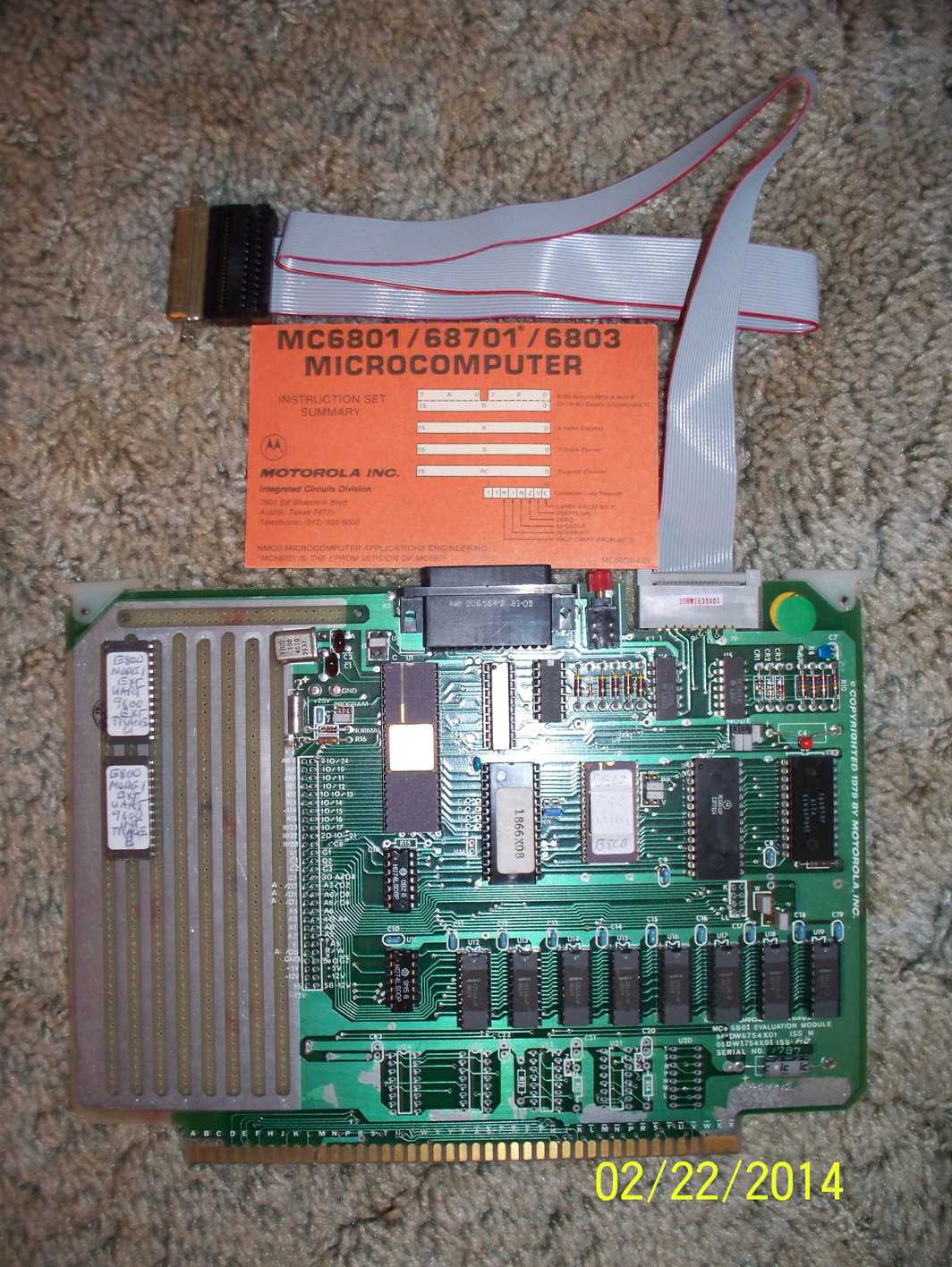
it was a prototype we used Motorola's 6801 evaluation module as the processing element in the tag reader. I still have
one of these 6801 evaluation modules. In addition to the photo of that chip card I mentioned above I had included photos
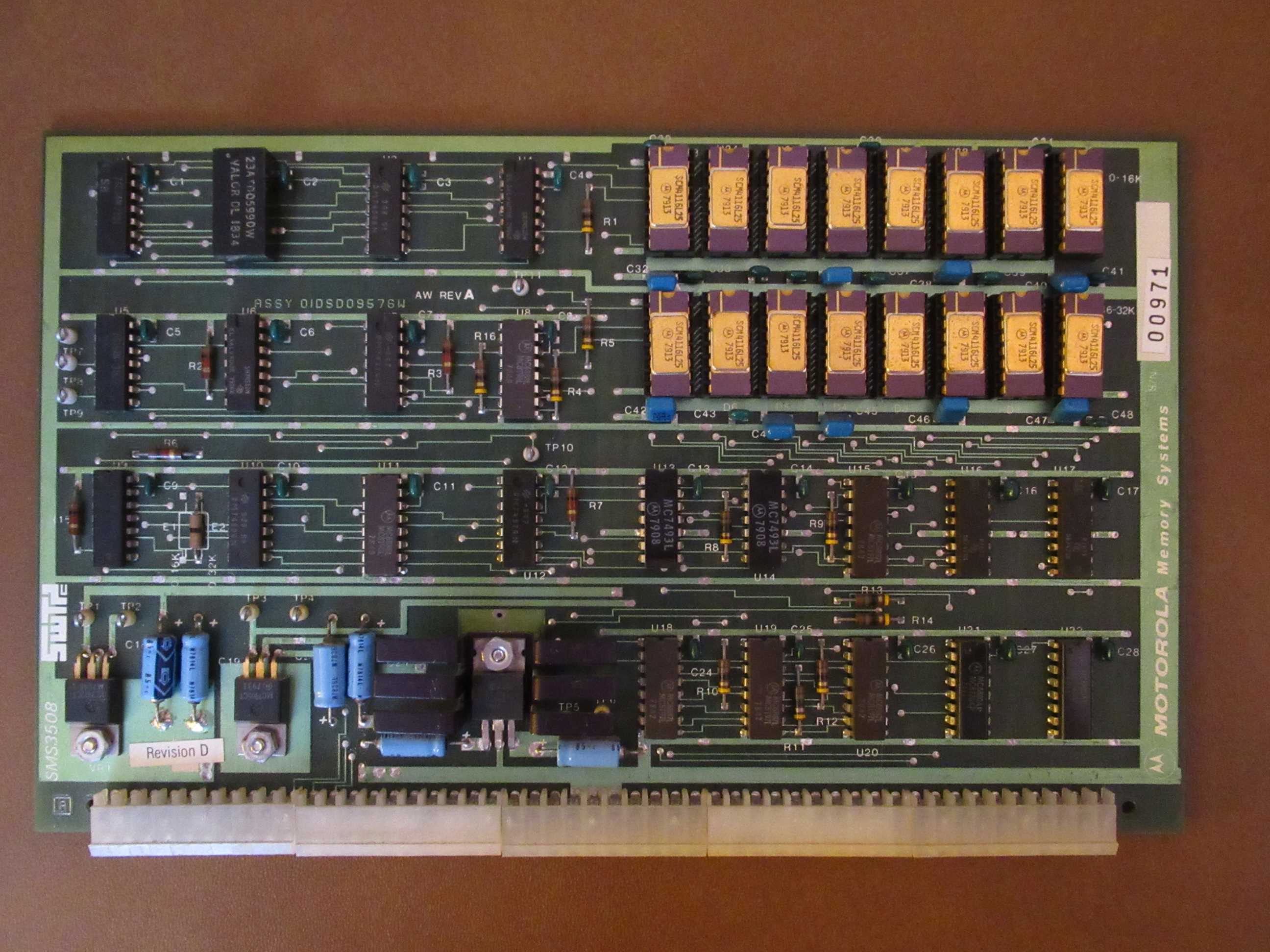
of my D2 kit and the 6801 evaluation module for your amusement. Finally somewhere along the way I acquired an SS50 32K
dynamic RAM card for the 6800 and was surprised to learn it was actually made by Motorola, photo also attached.
Ah, the memories!!!
73, Chris
MEC6800-EvaluationModule-Schematic-05-74.pdf
From: Stanley Ruppert
Date: Sun, 12 Jul 2026 21:15:52 -0700
A bit more fun trivia regarding the earliest Motorola Evaluation Card with MIKBUG.
From the early 1974 schematic Side Notes,
The MEC6800 board could be ordered in four different options/configurations:
Option 01 - MPU Model A, MIKBUG in single ROM XC6816 aka 6830
Option 02 - MPU Model A, MIKBUG in four 512x4 bipolar proms (Harris HM1-7621 pinouts)
Option 03 - MPU Model B, MIKBUG in single ROM XC6816 aka 6830
Option 04 - MPU Model B, MIKBUG in four 512x4 bipolar proms
Notably, the earliest revisions (Model A) of the 6800 did not (yet) support NMI
Options 01 and 02 with 6800 Model A (A1, A2) did not support /NMI interrupt (was grounded on evaluation board E3-E4 jumper)
Options 03 and 04 with 6800 Model B, did support /NMI interrupts so included additional R27 pullup resistor for NMI and removed
grounding jumper E3-E4.
From: "J. Chris Hausler"
Date: Mon, 13 Jul 2026 16:29:21 +0000
Hi Chris and Stan,
Very nice finds!!! Somewhere years ago I came across a very poor photo of one of those early boards. I never saw one "in the
flesh" however and the fact that they are apparently very rare explains why. I think the D1 was an effort by Motorola to
significantly reduce the cost so to get the processor directly in the hands of the engineers. I was working in the industry
at the time designing industrial command and control and feedback control software although on minis (Data General at the time)
and then even minis were new ideas to industry as well as my management. Management (at least mine at the time) would have been
reluctant to invest in educating their engineers about these even more newfangled chips :-)
I had been casually sniffing around micros for a couple of years but was not impressed by either the 8008 or 8080. Strangely,
early in 1976 I became interested in the F8 but further research turned me off to it. Although I had seen several copies of
Byte Magazine I bought my first one, the October 1976 issue, one Friday evening while visiting my local Heathkit store. There
were a number of articles in it which included 6800 code, I don't think I was even aware of the 6800 before this, and it
reminded me of some early experience with the first model of the PDP-11 mini (which I almost dropped on the floor due to
its under designed rack slides) while still in college. So I contacted my local Motorola sales office (eventually befriending
the sales manager) and he guided me to the kit. He also made me aware of a local hobby computer group which had formed earlier
in 76 and so I started attending their monthly meetings. I quickly became aware of a 6800 sub group and joined that as well.
Also the spring of 77 at the invite of a college friend who needed help manning his flea market booth, I attended my first hobby
computer convention in Trenton, NJ where I had the pleasure of briefly talking with John Mauchly, co-creator of ENIAC and
co-founder of what became UNIVAC, he (and his wife, an ENIAC programmer) were the keynote speakers at this convention.
Well it was all downhill from this point forward. For software for the D1, once I expanded it that summer with the 8K memory
board, I got both a 4K Basic and and editor/assembler set up for it, originally using that ASR33 as my terminal and program
storage device. At the time, the hobby magazines were casting about for ways to inexpensively distribute software. Byte
came up with "Paperbytes", a bar code system, and their first publication was for a single pass 6800 assembler. To this I
added TSC's Simple Line Editor with some enhancements to support assembly language programming and to control the ASR33's
paper tape reader and punch. I modified the assembler to control the reader. Interface Age had what they called "Floppy
ROMs" and their first one was a version of Bob Uiterwyk's 4K Basic ( https://en.wikipedia.org/wiki/Flexi_disc#/media/File:FloppyRom_Magazine.jpg ).
With only 8K total, his 8K Basic as well as Motorola's Co-Res editor and assembler were too large (with 8K I think I could
only get less than 6 lines of code in the editor before running out of memory :-). This was my "development system for the
rest of 77. Losing the TTY I constructed that hobby terminal in shown in the photo in my earlier email as well as the CSI-30+
for program storage. That was my system beginning in 1978 and several years thereafter.
However, my hobby computer efforts were more or less suspended summer 78 as I was shipped to a job site in Atlanta, GA for
almost two years, only getting back home every few weeks for a few days to catch up with mail and pay bills. So the 78 system
continued to be what I used for the next couple of years. However in Atlanta I quickly discovered a large hobby group, the
Atlanta Computer Society with a large 6800 sub group. Both held monthly meetings and I managed to make most of them. The 6800
group and several "lights" in the 6800 world, I remember chatting with Bud Pass on several occasions. This association, however,
taught me that the Exorbus was not the place to be for hobbyists and so in what little time I had at home I started acquiring
SWTPC bare boards and slowly assembled a 6800 system from them. By the time I got out of Atlanta (only to be sent to Houston
for a year :-) I had also assembled a 6809 system based mostly on SWTPC bare cards but some from other vendors as well. Of
course I attached the hobby terminal and the CIS-30+ to the SWTPC chassis and the D1's (and I also built a D2) got more or
less relegated to the shelves. Floppies (5 1/4) were added in 82 and in 1984 8 inch floppies as well (Shugart 851's).
Interestingly, by 84 8 inch floppies were already on their way out. The first two used 851's I bought cost about $60 a piece
and at the Trenton show in 85 I bought three more at $7 each. The date codes on the chips on these three 851's were 1984 so
they were almost new. All worked fine but one which required a minor repair to its index sensor. This remained my primary
system up into the late 1990's when due to outside issues I more or less dropped efforts in the 68XX world.
Also looking at my files on 68XX stuff for the first time in some time I came across an advertisement for a 6800 development
kit which included the chips mounted on a fancy card. The photo is poor quality but I have attached it. I wonder if this
was the earlier kit without the printed circuit card as when I got my first D1 the chips were not mounted on such a fancy card.
When I came back from my almost a year in Houston I was almost immediately sent out to Santa Cruz, CA (living in a hotel on
the beach, the Dream Inn, still there, :-) for a couple of months. This was the only paid work I ever did using 68XX
processors, in this case it was for a prototype RFID system intended to read the ten digit ID's off passing rail cars
traveling at 120 MPH in South Africa. The company which in California tradition was in a garage, likely a former muffler
shop, was Identronix. I could devote whole separate emails to stories about this company, the Dream Inn, Santa Cruz in
general, and what we did there. One of its principals was Vic Grinich who was one of the famous Traitorous Eight who
formed Fairchild Semiconductor ( https://en.wikipedia.org/wiki/Victor_Grinich (https://www.dreaminnsantacruz.com/) ).
He and I would go out to lunch together and he quite liked all the real time diagnostics I included in the firmware. As
it was a prototype we used Motorola's 6801 evaluation module as the processing element in the tag reader. I still have
one of these 6801 evaluation modules. In addition to the photo of that chip card I mentioned above I had included photos
of my D2 kit and the 6801 evaluation module for your amusement. Finally somewhere along the way I acquired an SS50 32K
dynamic RAM card for the 6800 and was surprised to learn it was actually made by Motorola, photo also attached.
Ah, the memories!!!
73, Chris